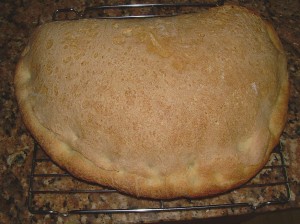
The Bread I Had to Make – Pane di Altamura

“The Singular Case of Pane di Altamura.” Am I referring to a Sherlock Holmes mystery, perhaps?
No, indeed. Something even better: a bread-baking adventure.
Months ago, I purchased Daniel Leader’s newest book, Local Breads: Sourdough and Whole-Grain Recipes from Europe’s Best Artisan Bakers

One chapter captured my attention and held me in thrall: The Singular Case of Pane di Altamura. I’m not really sure why, but the description of this bread and its history captivated me. ” . . . enormous, crudely shaped loaves the color of the sun, made with 100 percent semolina flour . . . .” Local Breads, p. 246. The Italian government has awarded the bread a prestigious DOP (denominazione di orgine protetta) designation, which is “reserved for agricultural and food products hose properties are essentially or exclusively derived from their geographical environment.” Local Breads, p. 247.
Recently, I decided to tackle Pane di Altamura, and an interesting adventure it was. For one thing, bread dough mysteriously has made it way onto my kitchen walls, cupboards, and other nooks and crannies. How did that happen? But I digress.
The Sourdough
The first thing I had to prepare was the semolina sourdough, which is made with yogurt and no added yeast. You mix 1/4 cup of tepid spring water (57 g), with 1/2 cup of fine durum semolina flour (70 g), and 2 Tablespoons (28g) of yogurt (low or nonfat is fine) with active yogurt cultures, preferably organic. You keep feeding the sourdough 1/4 cup of spring water and 1/2 a cup of semolina, without tossing off, for up to 10 days, until the sourdough is bubbly and frothy. This yields a dough-like sourdough, not a very liquid one.
On day 8, my starter was bubbly and frothy, or so I thought, so I made the bread। After six
I had just gone through a rather alarming amount of semolina, so there was no way I was throwing this out. This batch of dough currently resides in my freezer, soon to be made into focaccia. I split the remaining sourdough, fed both batches, put one in the refrigerator, and left the other one on the counter overnight. I fed the latter batch again before going to bed.
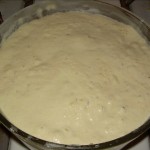 Determined to tackle Pane di Altamura again, I arose to a new day and the sight of a very happy starter. It was bubbling and gurgling, and seemed a lot more active after I’d halved it.
Some more notes on the sourdough: First, the book says that it will turn a brilliant yellow. To me, that means canary yellow, but my starter always remained a pale yellow. Second, between feeding the sourdough and baking the first batch of bread (the dud), I went through about 3.5 pounds of flour. I started with a 3 pound bag of King Arthur durum semolina, and ended up with Bob’s Red Mill durum semolina. Don’t even start this bread unless you have about 5 pounds of flour on hand, just in case, which is what I ended up using in total.
The Dough
After some research, I learned that one baker had to ferment another dough in Leader’s book (for Pierre Nury’s Rustic Light Rye) for seventeen hours. SEVENTEEN HOURS. I decided to make the dough again, and wait it out and see what would happen. On the day after I split the starter, I fed it in the morning, and whipped up another batch of dough later that afternoon.
I mixed the dough for about 20 minutes, not the 10 stated in the recipe. I would stop the stand mixer every once in a while and just let the dough rest, then I’d come back. If I had to add more flour, I did so judiciously. I’ve made this three times so far, and the dough should feel very dense, and a bit tacky, but still moist – like pizza dough.
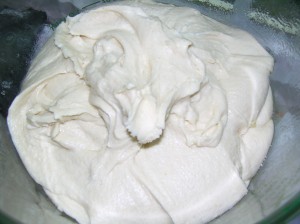
I should mention that when I made my first dud batch, I weighed everything on my kitchen scale. By the next day, my patience was wearing a tad thin, so I measured everything with U.S. measuring cups, and added flour by feel as I went along. I can’t really explain how I did this, I can only say that I was going to make this bread as many times as I needed to get it “right,” so I was willing to make mistakes. I really encourage novice bread bakers to go for it – there is no “test,” and you learn so much if you are willing to experiment. And you can always turn the duds into bread crumbs.
About four hours after I set the dough aside to proof, I casually walked into the kitchen to check on it, fully expecting to see nothing much happening. Well, the thing was alive, almost to the top of the bowl! So, I tossed it in the refrigerator overnight and hoped for the best (it was 10 p.m. by this time).
At 5:45 the next morning I launched myself out of bed. “What are you doing?” asked Master Chow. “I have to check on my bread!” I yelled as I ran for the stairs. “NOW?” he asked. Well . . ., yes. If you like to bake bread, I’m sure you’ll understand.
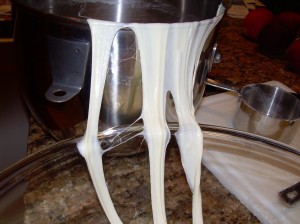
I completely skipped the step that called for a second proofing inside a kitchen towel and just formed the dough into the traditional Altamura loaf. In case you’re wondering what the dough feels like, it is just like cold pizza dough. The strands of gluten are amazing:
I proofed the dough for a couple more hours at room temperature, baked it, and ended up with the loaf at the top of this post. I have no idea what the bread should taste like, or what the crumb should look like, I can only tell you that it reminded me and my husband of San Francisco sourdough, which I like a lot. It’s not a bread I see myself baking again – as a loaf of bread – but I think it will make a great pizza. Look for a post on that in the near future.
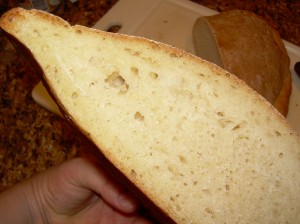
I took a look around my kitchen, and I knew that there was no way I was going to toss out all that beautiful semolina sourdough. So I made two more batches of dough -and they both proofed beautifully! One batch is in the freezer to be made into focaccia (along with my first dud), and the second I turned into an Altamura peasant loaf, pane del contadino. I proofed this one inside the towel before shaping: